What are you replacing?
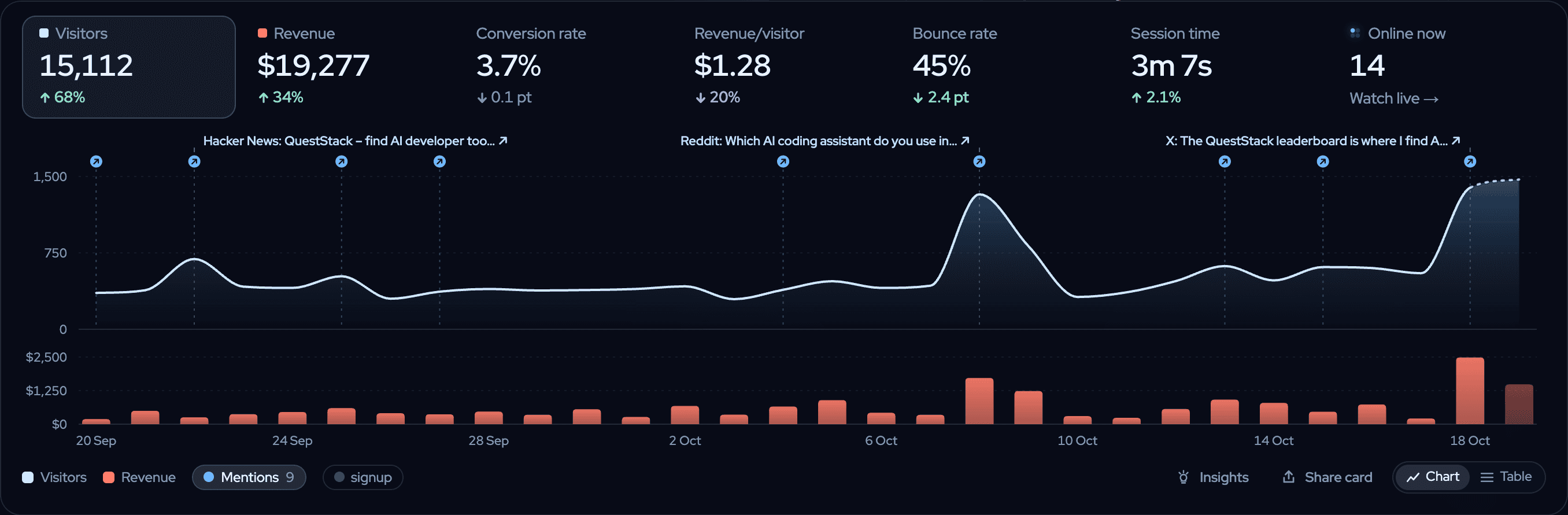
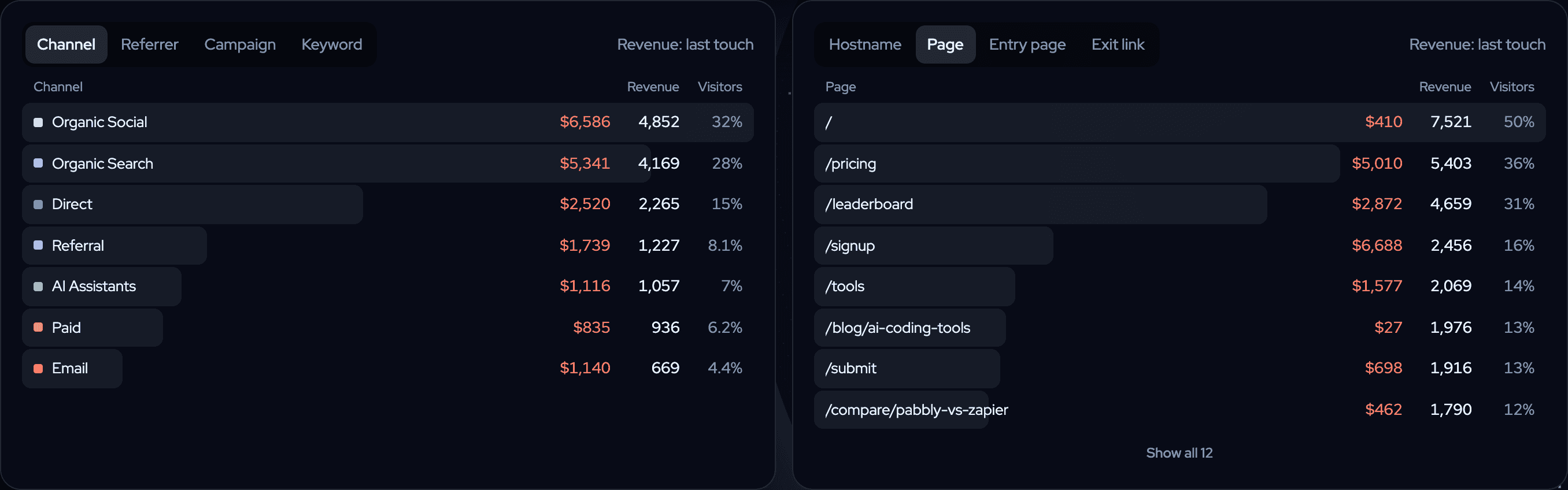
DataFast (datafa.st) is revenue-first web analytics. The homepage says it shows which channels bring paying customers. Starter starts at $9 a month and Growth at $19, for up to 10k events. The same two plans step up with volume through 10M, and a 10M+ step is $199 and $399. The FAQ describes a 14-day trial with no card. Funnels, journeys and an MCP server are part of the product. The data processing agreement says most of the infrastructure is outside the EU, including in the United States.
A replacement has to be clear about which of those you still need. A cookieless traffic counter is not a replacement if you chose DataFast for revenue. A product-analytics suite is not a replacement if you wanted one small dashboard. The notes below stay inside what each vendor's page said on 20 October 2026.
twelvebit: same price, tracking plan in the repo, data in the EU
twelvebit is the closest match on price and on the job. Starter is $9 and Growth is $19 at 10k events, and the published steps through 10M match DataFast's. Revenue comes from Stripe, Polar, Lemon Squeezy, Paddle, Dodo Payments, Shopify or WooCommerce, credited to the visit that led to the payment. Funnels, journeys and the live globe are on every plan, including Starter.
The differences that matter: a coding agent can install twelvebit from one prompt and keep the event list in analytics.yaml, which you review like code. DataFast's MCP server answers questions about an account you already have; we did not find a tracking plan that lives in the repo. twelvebit processes the data in Frankfurt and Vienna. The twelvebit trial is 14 days and the checkout asks for a card, so DataFast is easier to start. The full table is on twelvebit vs DataFast. Plans are on pricing. How a payment joins a visit is on revenue attribution.
twelvebit also imports ad spend from Meta Ads, Google Ads and Amazon Ads and shows the return of each campaign on the Ads page. If you sell on Amazon, your Amazon sales show next to your website revenue. DataFast's ad docs cover Meta Ads, and we did not find Amazon in its docs.
Choose twelvebit when you want that repo file, EU processing, Google and Amazon Ads next to Meta Ads, Amazon sales next to your website, or a Shopify app that does not depend on a script tag. Choose DataFast when the no-card trial, the published 10M+ price, or an install guide for your site builder is the thing you need.
Plausible: cookieless, EU-hosted, revenue on a higher plan
Plausible's pricing page, the same day, showed three plans on its first step: Starter at $9 a month (one site, 3 years of data), Growth at $14 (up to 3 sites and 3 team members) and Business at $19. Business is the plan that lists ecommerce revenue attribution, funnels and user journeys. The plans doc says every plan starts at the same pageview tiers, that the trial is 30 days with no card, and that yearly billing saves two months. The pricing page says Plausible is made and hosted in the EU, that the script uses no cookies, and that there is an open source edition.
Plausible suits you when you want no cookies by default and you are happy to put revenue, funnels and journeys on Business. It is a weaker swap if you wanted those on the $9 plan: that is Starter here and on DataFast, and Business on Plausible. Our Plausible comparison has a volume table checked on 19 October 2026, before this Growth price was on the page we read. Use Plausible's own pricing page for the current step.
Fathom: one plan, many sites, no cookies by default
Fathom's pricing page showed $15 a month for up to 100,000 pageviews, and a 7-day free trial. The same page describes cookieless analytics and says there is no consent banner for Fathom's analytics. Higher volumes are on the page; the selected plan in the text we read was the $15 step. It suits a person with several small sites who wants a single cookieless plan and does not need payment-provider revenue. See twelvebit vs Fathom for the volume table checked on 19 October 2026. Confirm the higher steps on Fathom's page before you decide.
Umami: a free cloud tier, MCP on Pro
Umami's pricing page lists Hobby at $0 a month for up to 100,000 events, 1 website and 6 months of data. Pro is $20 a month for 1 million events, up to 20 websites, up to 10 team members, 2 years of data, API access and MCP access, with a 14-day trial. Business is $200 a month and adds session replays and heatmaps. Hobby is the right DataFast alternative when you are under 100k events, you can live with six months of history, and you do not need payment-provider revenue. The pricing page we read did not describe revenue attribution. Pro is the step where Umami's own page says MCP access starts.
PostHog: a suite, with a large free analytics tier
PostHog is not a small analytics tool. The pricing page covers product analytics, session replay, feature flags, error tracking and more, and it says an open source product is MIT licensed. The analytics calculator on that page says the first 1 million events are free every month. That is a lot of room if you want product analytics in the same place as web analytics. It is the wrong swap if you wanted DataFast's single revenue dashboard and nothing else. We did not re-read PostHog's cookie or revenue docs on 20 October 2026, so this page does not repeat those claims. Their pricing page is the source for the free tier.
Simple Analytics: no cookies, a free plan, EU hosting on the pricing page
Simple Analytics' pricing page showed $20 a month at the 100k pageview step, and a free plan for hobby sites: 1 user, 5 websites, one month of history, with a badge. The same page says there are no cookies and no consent banners, and that the product is EU-hosted. It suits a content site that wants a one-page dashboard and does not need revenue from a payment provider. We did not find revenue tracking on that pricing page.
Pirsch: a low entry price and many sites
Pirsch's pricing page says it starts at $6 a month for 10,000 monthly page views. At that step, Standard is $6 and includes 50 websites, and Plus is $12 and adds funnels, teams and white labeling. The trial is 30 days and the page says no credit card is required. Pirsch suits a group of small sites that must stay cheap. The pricing text we read did not describe payment-provider revenue, so do not assume it replaces DataFast's revenue view. Check their pricing page for the step above 10k before you compare it with a $9 plan at 100k.
Which DataFast alternative is free?
Three have a free cloud tier on the pages we read. Umami Hobby is $0 up to 100k events a month, with one site and six months of data. PostHog includes the first 1 million analytics events each month. Simple Analytics has a free plan for up to five sites, one month of history and a badge. Plausible's plans doc describes a 30-day trial with no card, not a free plan. DataFast's free offer is the 14-day trial, also with no card. twelvebit has no free plan. It starts with a 14-day trial, and the checkout asks for a card.
Which ones attribute revenue?
twelvebit and DataFast both connect payment providers and show revenue next to traffic. On the pages read for this article, Plausible puts ecommerce revenue attribution on the Business plan. Fathom, Umami, Simple Analytics and Pirsch did not describe payment-provider revenue on the pricing pages we opened. That does not mean a feature is absent from the whole product. It means we did not see it there, and the table says so. If revenue by channel is why you use DataFast, start with twelvebit vs DataFast and twelvebit vs Plausible, then confirm the others on their own docs.
What about Shopify?
Shopify has blocked new script tags since 1 October 2026 and stops running them on storefronts on 1 March 2027. DataFast's Shopify guide still tells a merchant to create a custom app with the write_script_tags scope so DataFast can install its script. twelvebit's Shopify app uses an app embed and a web pixel instead. If the store is the reason you are looking for an alternative, read Shopify's changelog and the ecommerce page before you pick on price alone. A tool that only loads through a script tag will stop counting storefront visits on 1 March 2027, whatever the monthly price is.
How do you move?
Add the new script next to DataFast and run both for a week. Rebuild the goals you actually use. Connect the payment provider if the new tool supports it. Compare visitors and revenue, then remove the DataFast script. twelvebit cannot import DataFast history. With twelvebit, the coding agent does the setup from one prompt: see agent setup and the MCP server.
When to stay on DataFast
- You want a 14-day trial with no card. DataFast's homepage and FAQ still say that. Several alternatives ask for a card, or a shorter trial.
- You already connect a payment provider there and the revenue reports are the ones you use. Moving costs a week of running two scripts, and nobody on this list imports DataFast history.
- You want a published price above 10 million events a month. DataFast lists a 10M+ step at $199 (Starter) and $399 (Growth). twelvebit does not publish a price there.
- You install from a no-code tool DataFast documents (Webflow, Framer, Bubble, Wix, Squarespace, Ghost, Podia, Kajabi, Google Tag Manager) and you do not need a tracking plan in git.
Also see Google Analytics alternatives if you are leaving GA4 rather than DataFast. The facts on that page were checked on 19 October 2026.
How we compared
We read the pages linked below on 20 October 2026. Prices are monthly. For Plausible, Fathom, Umami, PostHog, Simple Analytics and Pirsch we used the pricing page (and Plausible's plans doc), not a full product review. Where that page did not mention a feature, the table says so instead of guessing. twelvebit's prices come from the same plans table as /pricing. DataFast's prices come from the public pricing config in its homepage and from the prices the homepage showed at 10k.
Sources
Facts about other tools come from their own pages, read on 20 October 2026. Prices change; check the vendor's page before you decide. Write to hello@twelvebit.io if something here is out of date.
- DataFast: Home and pricing, Data processing agreement, Cookieless tracking, Shopify
- Plausible: Pricing, Plans
- Fathom: Pricing
- Umami: Pricing
- PostHog: Pricing
- Simple Analytics: Pricing
- Pirsch: Pricing